Showing posts with label Flora. Show all posts

Friday, September 27, 2013

Devil's Backbone


Devil's Backbone
 
We visited Devil's Backbone for the second time on Wednesday this week.  It was an absolutely gorgeous day to be outdoors!  Devil's Backbone is located in the foothills west of Loveland, just north of Hwy 34.  It is the southern access point to an extended trail system that extends north, running along the hogbacks that run between Loveland and Fort Collins.


The trail can be shared by hikers, mountain bikes and horses.  The trail initially goes to an outlook point, where you can look into the next valley and see the entire front range.  It is an easy trail, with a gradual incline, and it is about 1.6 miles roundtrip from the parking lot.  You could easily continue to hike northward, and do the whole circuit - about 5 miles or so?  This picture above shows the strata quite well.  The hogbacks are made up of sandstone, upheaved eons ago.  It is very easy to study the strata on this hike.


Here we are at the lookout.  There is a nice sign to name off the peaks in the distance.  Long's Peak is to the left of Jordan's head.  The mouth of the Big Thompson Canyon is above my head, behind that distant ridge.  The flooding that happened from the rains two weeks ago has caused widespread damage all along the river basin.  You can't see it from this vantage point, but just a quarter mile to our south is where the Big Thompson river runs south of Hwy 34, and the flood has most certainly left it's mark.  After our hike we drove a short ways until we reached the road closure, and were just amazed and saddened at the destruction we saw.  Mud and debris everywhere...  Shortly after a group of hikers took this picture of me and the kids, another lady arrived and chatted with us a bit.  She was from Baton Rouge, LA, and was here volunteering at the Loveland shelter with the Red Cross.  She was enjoying a day off and seeing the sights.
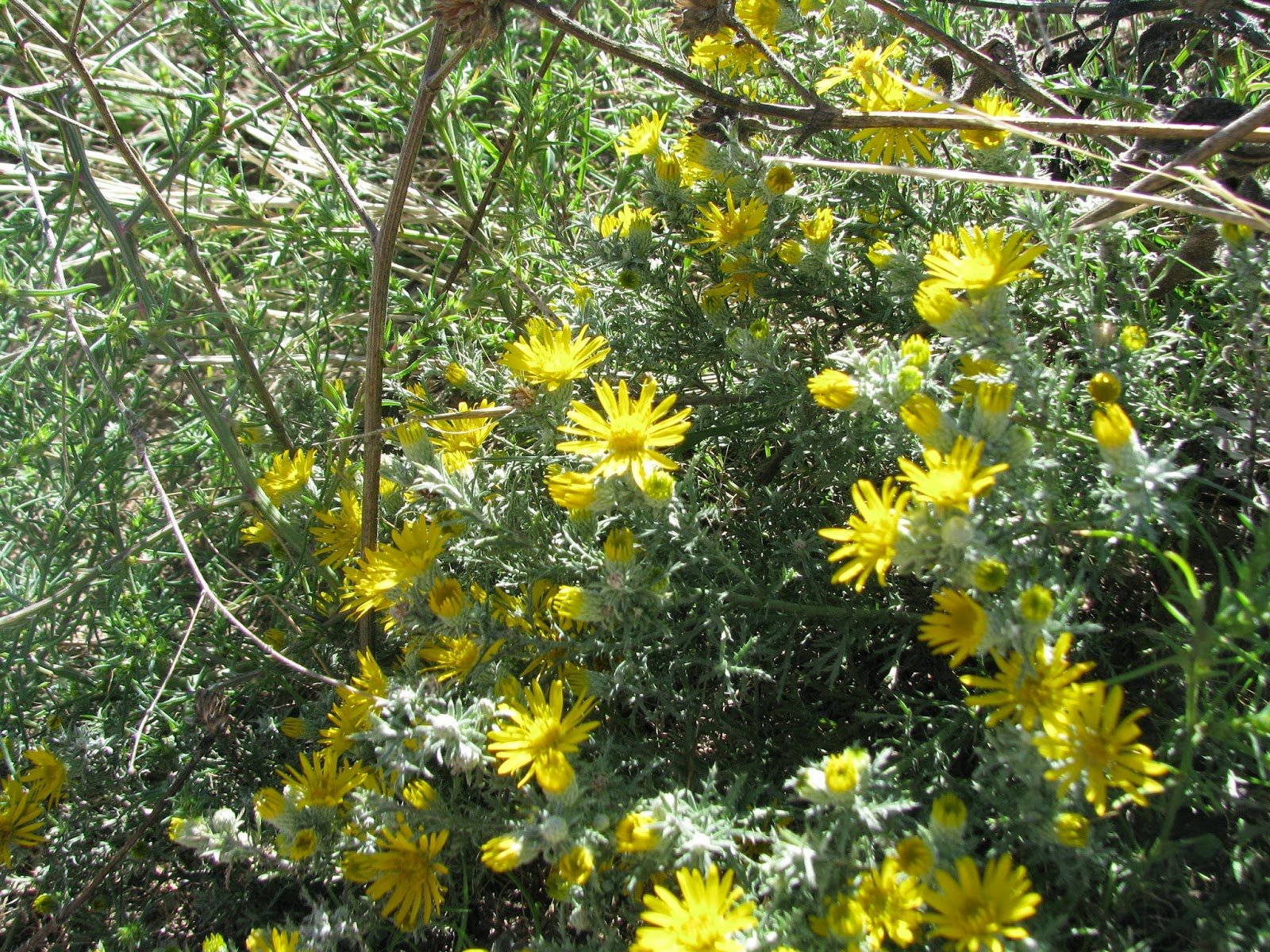


Since this was technically a girl scout hike (even though Rylan was the only scout in attendance), I covered with her some more backcountry advice and worked on naming plants with her.  We saw several Lacy Tansyasters (above) along the trail, which can be easily identified by their trademark daisy-like petal formation and delicate, lacy, sage-green foliage and round bushy habit.  We also identified yucca, pear cactus, sage, cottonwood, chokecherry, golden currant and yellow rabbitbrush (below).


I didn't get any pictures, but we also watched two bald eagles circling, as well as a red-tailed hawk and a kestrel.  The only other creatures we saw were beetles and pesky grasshoppers - including a monster-sized one that was four inches long! 


The biggest win for this hike was the fact that both Owen and Colin made it the whole way.  Usually Colin requests to be carried, but here he is, almost near the end of the hike, still going strong!  Owen was fueled by something else - he really, really, really needed to go potty.  ;)


Thursday, April 26, 2012

Dragonfly's Lair - First Visit (4/16/12)


Last week we visited Dragonfly's Lair, just a hop, skip and a jump from our house.  It was built through community effort and the organization Trees, Water and People about 8 years ago.  You can read more about it here.

This was technically our second visit.  We first came here three years ago, when we attended an aquatic insect class with our homeschool group.  We used field microscopes and looked at several water samples, counting all of the different life forms we could find.  The more you find, the healthier the aquatic ecosystem.  We enjoyed using the microscopes so much, that we bought one as a Christmas gift to the entire family.


We take it with us on every outing - it is very lightweight and portable.  You can order all sorts of extras to suit your needs.  Here is the model we own.  I highly recommend it!

Unfortunately, this outing yielded disappointing results.  Jordan took about six different water samples from different locations around the edge of the pond, and could not find any aquatic insects.  That is not to say there isn't any there, but judging from the visual survey of the pond, it did not look very healthy.  Yet - it must hold at least some degree of sustainability, because this couple was watching us the entire time...

A. Platyrhynchos

I still can't understand what is going on with my camera, because I tried to zoom in, and this was the best I could do.  I was only standing about thirty feet away!  Certainly I can turn out a better picture of Mallards, but for now this will have to do.

There is an interpretive trail with ample signage that identifies all of the local plants they installed years ago.  There also used to be a large deck unit, with a walkway that crossed over the entire marsh/pond, but it is gone now.  I searched around on the internet to look for any stories about it, but there doesn't appear to be any.  We were sorely disappointed about that too - that was one of the best features of the area.  You can get an idea of what it was like by clicking on the link I posted at the beginning.

We were able to see some good examples of blooms on native plant life...

Common Chokecherry (Prunus virginiana vars. demissa & melanocarpa)

Golden Currant (Ribes aureum )
We will make the effort to return in a couple on months to see if things have improved.  I might even call the city's outdoor education office to see if they still offer the class (and ferret out the reason why the walkway was removed).  The funny thing - after we got home, I realized that one of our shrubs out in front of our house looks exactly like the one above.  Ha!  At least now I know what to call it!

Wednesday, February 1, 2012

Yucca

aka:

Great Plains yucca

Spanish bayonet

beargrass

small soapweed

soapweed yucca


In these parts, we just call it 'yucca'

Cathy Fromme Prairie, 1-31-2012


KingdomPlantae– Plants
SubkingdomTracheobionta– Vascular plants
SuperdivisionSpermatophyta– Seed plants
DivisionMagnoliophyta– Flowering plants
ClassLiliopsida– Monocotyledons
SubclassLiliidae
OrderLiliales
FamilyAgavaceae– Century-plant family
GenusYucca L.– yucca
SpeciesYucca glauca Nutt.– soapweed yucca


The above information came from this site.  The yucca is a native plant to this area, and is obnoxious enough that it has garnered 'weed' status.  I think it deserves a better classification than that.  It is an iconic plant in this region, and it is very pretty, IMHO.  My grandpa Orin thought so too, because I would venture to guess he photographed at least a hundred of them as he criss-crossed all over Colorado and the southwest years ago.

A yucca plant grows to be about a foot tall and produces beautiful white blooms in the late spring/early summer.  It retains the beautiful green foliage all year long, and it is such a pretty contrast when it is covered with snow.  The plant isn't very tasty to animal or human, but it isn't toxic, either.  Many Native American tribes used the fruit/seed pods/roots as a food source.  The fruit was a preferred item, and the root was a last-resort item used in time of famine.  The Keres (Pueblo Indian Tribes of New Mexico) even used the fruit to boil it down into a syrup and make hot chocolate.  I'll take their word for it.

I found a long list of various maladies and medical conditions that the Native American tribes of the midwest region used different parts of the yucca to cure.  The Blackfoot, Cheyenne, Dakota, Kiowa, Lakota all used it to treat baldness or promote hair growth.  They must have been on to something, or else it was the same medicine man that traveled from tribe to tribe pitching his natural cure for baldness.  I find it hard to believe that baldness was a true concern at the time...but according to the ethnobiologists that studied these tribes, it was.  The root, after a good pounding, produces a nice soapy froth that was used as a shampoo (hence the name, small soapweed) and as a way to treat lice or sooth the effects of poison ivy.   The juice from the leaves was used as a poison on arrowheads and for fishing - which flies in the face of the claim that the plant is not poisonous.  There are contradictions all over the place on the internet! (So don't you dare use me as a primary source!!)

One very interesting fact is the symbiotic relationship between the yucca plant and the pronuba moth.  Neither one can exist without the other.  The moth, in its pupal stage, will remain underground in its cocoon until the yucca is in bloom in the late spring.  The white flowers fully open at night and give off a very particular scent.  The moth detects the scent, emerges from the ground, and begins to pollinate the plants.  The female will gather pollen from the stamen of one plant, visit another, and deposit her eggs in a very specific spot in the ovary, and then shove her ball of collected pollen (3X the size of her head) into a receptacle on the tip of the ovary's stigma.  Pollination then occurs, and when the larvae emerge a few days later, their singular food source (the seeds) is right there, ready to go, housed within the seed pod that also serves as protection for the larvae.  When the larvae emerge from the seed pods, they drop to the ground after a rainstorm (when the ground is soft), dig down a couple on inches and build a cocoon and start the whole process over.  They can remain underground for just a few weeks or for years, until the yucca blooms again.  Fascinating!  If you want to see a pronuba moth, you can find them (when the yucca is in bloom, of course) resting on/within the blooms during the daytime, and between the hours of dusk and midnight, flying from yucca  to yucca as they gather pollen.  They are silvery white in color and about an inch in length. 

We have our work cut out for us this coming early summer.  I want to document a yucca in bloom, watch for pronuba moths, and collect a seed pod for study under the microscope.

Good stuff!